


How to Repair Heat Damaged Hair A Trichologists 6 Week Protocol
How to Repair Heat Damaged Hair: A Trichologist's 6 Week Protocol

If your hair feels like straw, breaks when you tie it back, and looks fried even on a good hair day, you are looking at classic heat damaged hair. The good news: it is one of the few hair problems a trichologist can actually reverse — not perfectly, but to a clinically meaningful degree — if you commit to a structured six-week protocol. This is a complete how to repair heat damaged hair roadmap, not a generic listicle. The bad news: most "miracle" masks on the market treat the symptom (dryness on the outside) without rebuilding the protein and lipid bonds on the inside. This guide is the protocol our trichology team in Guangzhou uses with clients who walk in after months of flat iron damage hair or aggressive blow dry damage repair cycles. It is split into six weeks so you can layer protein, lipids, and moisture in the correct order — the order is what most people get wrong.
How Heat Damages Hair at the Protein Level

Every strand of hair is roughly 65-95% keratin protein, with the rest being water, lipids, trace minerals, and melanin. The keratin chains are held together by three types of bonds: hydrogen bonds (weak, broken by water), salt bonds (broken by pH shifts), and disulfide bonds (strong, only broken by chemical treatments or extreme heat). When you clamp a 230°C flat iron on a strand for ten seconds, you are doing three things at once: evaporating the water inside the cortex, denaturing the keratin protein so it loses its helical shape, and literally melting the lipid layer that sits between the cuticle scales. The visible result — the puff, the frizz, the split end — is a downstream symptom of structural damage you cannot see.
Understanding this mechanism is the reason every credible heat damaged hair treatment works in roughly the same order: stop further damage first, then replace the protein that was denatured, then seal the cuticle with lipids, then maintain the new structure with lower-heat habits. Skip the order and you waste product. Apply protein before you stop the heat and you bake the damage in deeper. The protocol below assumes you are dealing with mild-to-moderate thermal damage (Levels 1-3 in the next section). Severe damage with visible breakage across the crown should still follow this plan, but expect a 12-week timeline and budget for a trim at week 6.
The 4 Levels of Heat Damage (and What Each Looks Like)

Before you start the six-week protocol, you need to honestly grade your damage. Trichologists classify thermal damage into four levels based on three checks: the stretch test (pull a wet strand — does it stretch and snap, stretch and stay stretched, or break immediately?), the cuticle test (run a strand between your fingers from root to tip — does it feel smooth all the way, gritty, or rough?), and the porosity water test (drop a clean strand in room-temperature water — does it float, sink slowly, or sink fast?). Your level tells you how aggressively to push protein vs. moisture in weeks 3-6.
| Level | Visual signs | Stretch test | Porosity | Repair timeline |
|---|---|---|---|---|
| Level 1 — Mild | Slight frizz, dry ends, color fades faster | Stretches and returns | Normal | 4-6 weeks |
| Level 2 — Moderate | Rough texture, visible split ends, tangles | Stretches, snaps at end | Slightly high | 6-8 weeks |
| Level 3 — Severe | "Gummy" wet hair, breakage, fried look | Stretches and stays stretched | High porosity | 10-14 weeks |
| Level 4 — Irreversible | Hair melts, breaks above the elastic, smoke damage | Breaks immediately | Extreme | Cut required |
If you land at Level 1 or 2, this protocol will fully reverse what you are seeing. Level 3 will see 50-80% recovery plus a 5-7 cm trim at week 6 to remove the worst of the split ends. Level 4 is outside what topical care can fix — you are looking at cutting back to the healthy growth line and starting the protocol on the new growth. We expand the porosity / stretch-test methodology in Which treatment is best for hair?, where we go deeper on how to read your hair's response to the test.
Week 1-2: Stop the Bleeding (Reduce Heat 70%)
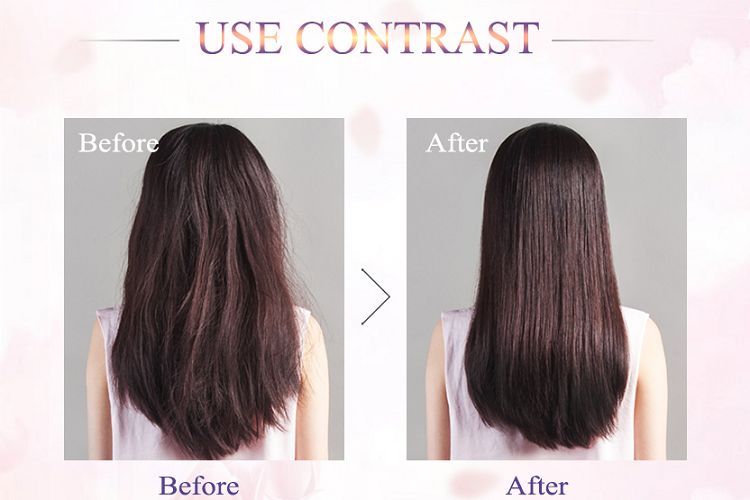
The most expensive mask in the world cannot out-pace a 220°C flat iron used three times a week. Weeks 1 and 2 are not about adding products — they are about removing heat exposure so the rest of the protocol has something to work with. The target is a 70% reduction in cumulative weekly heat exposure measured in degrees-seconds: if you currently flat iron for 15 minutes at 220°C three times a week (3 x 15 x 60 x 220 = 594,000 degree-seconds), the new target is around 178,000 degree-seconds. That sounds abstract; in practice it means cutting your heat sessions to 5-7 minutes, dropping the temperature to 180°C, and limiting heat to once per week. Air-dry on weekends is impossible.
During these two weeks you are also rebuilding the lipid layer on the cuticle. A lightweight, silicone-free leave-in applied to damp hair twice a day does the job — we typically recommend a formulation with hydrolyzed wheat protein, panthenol, and a small percentage of lightweight silicone (cyclomethicone or dimethicone at 1-2%) so the hair can slide without being sealed under a heavy occlusive. Avoid coconut oil during weeks 1-2 because it has a high affinity for the hair shaft and will block the protein treatments you start in week 3. Is Argan Oil Good for Hair? Discover the Benefits for Hair and Skin walks through the difference between argan oil (good in this phase) and coconut oil (better in week 5-6).
- Wash schedule: every 2-3 days with a sulfate-free, low-pH shampoo (5.0-5.5). Daily washing strips the new lipid layer.
- Heat tool cap: 180°C max on flat irons, medium setting on blow dryers, no more than once per week.
- Wet hair handling: do not brush wet hair. Use a wide-tooth comb starting from the ends, working up. Wet hair is 3x more elastic and snaps easily.
- Sleep protection: silk or satin pillowcase, or wrap hair in a silk scarf. Cotton pillowcases create friction that reverses the lipid work you did during the day.
By the end of week 2 you should notice two changes: tangles are easier to work through, and your hair feels less "crispy" when you scrunch it dry. If you do not see these changes, the heat reduction was not aggressive enough — cut another heat session.
Week 3-4: Replenish Protein and Lipids

Now that heat exposure is under control, this is where the real heat damaged hair treatment work happens. Weeks 3 and 4 introduce hydrolyzed protein to fill the gaps left by denatured keratin, and lipid-rich masks to restore the 18-MEA layer on the cuticle. The mistake most people make here is going pure protein for two weeks straight — this overshoots into a stiff, brittle texture because you are rebuilding structure without flexibility. The correct pattern is protein + moisture + lipid in the same mask, twice a week, for two weeks.
What to look for in a protein treatment: hydrolyzed keratin (molecular weight 1,000-5,000 daltons — larger molecules sit on the surface and cause stiffness), hydrolyzed silk (for shine and slip), and hydrolyzed wheat protein (for flexible strength). What to look for in the lipid component: ceramides (the same family your scalp produces naturally), fatty alcohols like cetyl and cetearyl, and natural oils with a high linoleic acid content (argan, grape seed, safflower). A weekly hot-oil session of 15-20 minutes under a shower cap adds a deeper lipid layer on top of the mask. Karseell Private Label Hair Care Shampoo and Conditioner – Promotes Healthy Scalp and Hair-OEM And ODM Services Available lists the formulation markers we look for in a salon-grade repair mask.
During these two weeks also start lowering your shampoo water temperature. Hot water (above 38°C) swells the cuticle and strips the new lipid layer you are working to build. Lukewarm (30-33°C) keeps the cuticle lying flat so the protein and lipids actually bond to the strand instead of being washed out. A 60-second cold-water rinse at the end of every wash is the single highest-ROI habit in this entire six-week plan.
Week 5-6: Rebuild the Cuticle
By week 5 the protein and lipid work from weeks 3-4 has restored most of the cortex damage. What remains is the cuticle — the overlapping shingle-like layer on the outside of every strand that gives hair its shine and reflects light. Heat damage physically lifts these shingles. Rebuilding means sealing them back down with a combination of acidic rinses (pH 3.5-4.5), heavier leave-in conditioners with positive charges that bind to the negatively-charged damaged sites, and one targeted trim to remove the worst 2-3 cm of split ends that developed during the damage phase.
The cuticle-sealing acidic rinse is the same idea as a vinegar rinse, formulated correctly. Apple cider vinegar (1 tablespoon in 250 ml of water) works in a pinch; a professionally formulated acidic rinse with citric and lactic acid is more consistent. Pour it over the hair after your conditioner, wait 60 seconds, then rinse with cold water. The cuticle contracts and lays flat, which immediately improves shine and reduces tangling. From this point you can also reintroduce coconut oil — its high lauric acid content binds well to the now-rebuilt cuticle and seals moisture inside the cortex. We cover the cuticle-rebuild chemistry in Why Now is the Perfect Time to Partner with Karseell for Hair Care Products in the context of mass-market formulation work.
Week 6 is also when most clients see the inflection point in their hair's behavior. The wet-hair stretch test should now return a healthy snap-back instead of stretching and staying stretched. Tangle time at the shower should drop by 50%. Frizz under humidity should noticeably decrease. If those three markers are not yet there, extend weeks 5-6 for another 7-10 days before moving into maintenance. For clients with extensions, How to Maintain and Protect Your Keratin Bonded Hair Extensions explains how the same six-week plan needs an extra weekly bond-check if you are wearing keratin-bonded extensions.
Long-Term Maintenance Habits
The six-week protocol is the recovery; the maintenance habits are the relapse prevention. About 60% of clients who finish the protocol see their damage return within four months because they go back to old heat habits. The minimum maintenance stack looks like this:
- Heat tool cap: never above 180°C on flat irons, always below 190°C on curling wands. Anything above 200°C will start denaturing keratin regardless of the protectant.
- Heat protectant: a silicone-and-protein hybrid applied to damp hair before any heat. Silicones create a thermal buffer that slows heat transfer into the cortex.
- Protein treatment cadence: one hydrolyzed-keratin mask per week as prevention, not as recovery. Once the cortex is rebuilt, the goal is to replace the small amounts of protein lost to daily wear.
- Trim cadence: every 8-10 weeks, removing 1-2 cm. Split ends travel up the shaft if not cut; one ignored split can split into three within a month.
- Diet support: 60-80g of protein per day and 2-3L of water. Hair is 25% protein by dry weight; you cannot supplement your way out of a dietary deficit.
The most underrated maintenance habit is the order you apply products. Conditioner before shampoo is wrong; leave-in before heat protectant is wrong; oil before a protein mask blocks absorption. The correct sequence is: shampoo (lather 60 seconds) → conditioner (mid-length to ends, 2 minutes) → cold rinse → towel dry to remove dripping → leave-in on damp hair → heat protectant if heat styling → style. We discuss the science of leave-in layering in Will goat milk make your hair grow back?, where we compare protein sources and biology ingredients for long-term post-treatment routines.
FAQ: Heat Damaged Hair Repair
Can heat-damaged hair actually be repaired?
Yes — mild to moderate heat damage (Levels 1-3 in this guide) is reversible to a meaningful degree with a structured protein, lipid, and moisture protocol over 6-14 weeks. The cuticle and cortex can be restored to roughly 70-90% of their pre-damage condition. Severe damage where the hair physically melts (Level 4) cannot be repaired topically — that hair must be cut back to the healthy growth line.
How often should I use a hair mask?
During active repair (weeks 3-6 of the protocol): twice a week. During maintenance: once a week is enough to replace the protein and lipid loss from daily wear. More than twice a week risks protein overload, which makes strands stiff and brittle in a different way from heat damage.
Is heat protectant enough?
No. Heat protectant creates a thermal buffer that slows heat transfer, but it does not stop it. At 230°C with three passes per section, even the best protectant cannot prevent the cortex from reaching denaturation temperature. Heat protectant is one layer of defense — lower temperature, fewer passes, and less frequent heat styling are the other three layers.
What temperature is safe for flat ironing?
For fine or color-treated hair: 150-170°C. For normal hair: 170-185°C. For coarse or very curly hair: 185-195°C. Anything above 200°C denatures keratin regardless of hair type. The myth that "you need high heat to set a style" is wrong — passes per section and clamp pressure matter more than peak temperature for hold.
Should I cut off all damaged hair?
No — not all of it. Trichologists typically recommend removing the worst 2-5 cm at week 6 of the protocol, where split ends concentrate. Cutting more than that before the cortex is restored wastes healthy length. The exception is Level 4 damage, which requires cutting back to the last point where the strand is structurally sound.
Does coconut oil help heat-damaged hair?
Yes, but only at the right time. Coconut oil has a high affinity for the hair shaft and can penetrate the cortex, which makes it useful for restoring flexibility in weeks 5-6 of the protocol. It is counterproductive in weeks 1-2 because it blocks the hydrolyzed protein treatments from absorbing. The same logic applies to most heavy natural oils — argan, olive, and avocado are all better as a finishing lipid than as a primary treatment.
Article last updated: 2026-10-07 | Author: Karseell Editorial Team | Reviewed by: Guangzhou Chinchy Cosmetic Group Trichology Partner
